Backyard Wedding in Missouri: The Complete Planning Checklist
A practical, Missouri-specific checklist for planning a backyard wedding — permits, climate, capacity, vendors, restrooms, insurance, and the things couples wish they'd known six months earlier.
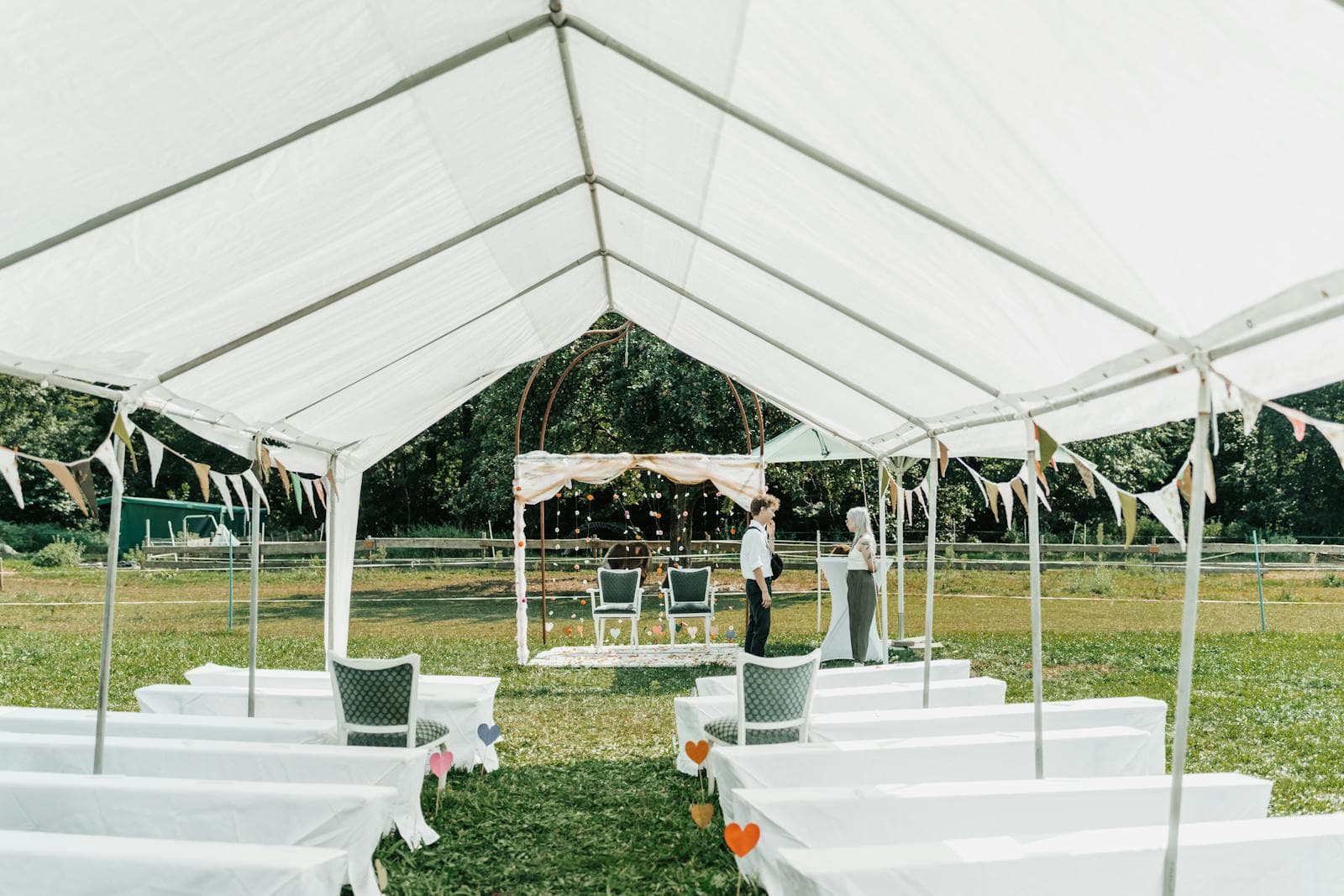
A backyard wedding in Missouri is roughly equivalent to building a temporary venue from scratch — every piece of infrastructure that an established venue provides (parking, restrooms, electricity, weather contingency, food service capacity) you have to source separately. It can absolutely be done well, and the result is often more personal than a traditional venue. But it requires more planning, not less. This checklist walks through everything specific to Missouri and the St. Louis area.
Before you commit: the four-question gut check
Before booking anything, answer these honestly:
- Can your property handle the guest count you want? As a rough rule, you need about 12 square feet per seated guest under a tent, plus circulation space. A 100-guest reception under a 40×60 tent occupies most of a typical suburban backyard.
- Can your neighbors handle it? Sound carries. So does parking. Your relationship with neighbors will be tested by music, voices, and cars. Talk to them early.
- Is your driveway and street layout viable for vendor trucks and guest parking? Caterers, florists, tent rental, restroom delivery — that's 4-6 vehicles arriving over a few hours.
- Do you have a real Plan B for weather? Missouri weather doesn't always cooperate. Tents help. Indoor backup helps more.
If any of these are a "maybe," start there before continuing.
Permits and noise ordinances
Missouri doesn't require a state-level wedding permit, but local rules are real and surprise people. The most relevant ones for the St. Louis area:
St. Louis County (unincorporated)
- Noise: General noise ordinance limits "unreasonable noise" between 11 PM and 7 AM. Outdoor amplified music after 11 PM is risky.
- Tents: Tents over a certain size (typically 200+ square feet) require a building permit from the county. Tent rental companies usually pull these.
- Parking on streets: Generally allowed but check signage.
City of St. Louis
- Noise: City noise ordinance is similar — 11 PM cutoff for amplified outdoor sound.
- Public events on residential property: Generally permitted as private gatherings; large-scale events may require coordination with the alderperson's office.
- Street parking: Verify residential parking restrictions for your street.
St. Charles County
- Noise: Similar to St. Louis County — restrictions kick in late evening.
- Special event permits: Required for events on public property; backyard weddings on private property generally don't require one but check the unincorporated county code if you're outside city limits.
Common to all jurisdictions
- Open flame: Fire pits, candles, sparklers — most municipalities allow these but may have restrictions during burn bans (common in dry summer months).
- Alcohol: Private gatherings on private property generally don't require a permit. If you sell tickets or charge guests for drinks, that becomes a different legal situation.
The vendor checklist
Below is the typical vendor list for a backyard wedding. Order them roughly in this sequence to avoid scheduling conflicts.
- ✓Tent rental (book 6+ months out for peak season)
- ✓Tables, chairs, linens, place settings
- ✓Catering (verify they have backyard-event experience)
- ✓Bar service / bartender (separate from catering, often)
- ✓Restroom trailer rental (book early — peak weekends fill 6-12 months out)
- ✓Generator (if your home power can't support tent lighting + DJ + bar coolers)
- ✓Photographer
- ✓Videographer (optional)
- ✓Florist
- ✓DJ or band + sound system
- ✓Officiant
- ✓Hair and makeup
- ✓Day-of coordinator (highly recommended for backyard events)
- ✓Cake or dessert
- ✓Lighting (string lights, uplighting, ceremony lighting)
- ✓Trash and recycling service (don't underestimate this)
- ✓Valet or parking attendant (for events over 75 guests)
- ✓Insurance (event liability, rider on homeowners — see below)
Restrooms — the part most often underestimated
Your home's bathrooms cannot handle 100+ guests across an 8-hour event. Even if they could mechanically (most can't — septic systems and shared drainage struggle with that volume), you don't want guests tracking in and out of your house all night. Practically every backyard wedding over ~30 guests rents at least one restroom trailer.
Quick sizing rule for backyard weddings:
- Up to 125 guests: 2-stall trailer
- 125–300 guests: 4-stall trailer
- 300+ guests: 6-stall trailer or larger
Backyard placement is usually easier than venue placement (you control the property). The trailer typically goes near a side or back property line where it has space and is out of the main visual line. We need:
- A flat or level area large enough for the trailer (~12 feet wide, 16-32 feet long depending on size)
- Truck access to the placement spot (most driveways work fine)
- Power source (a 30A or 50A outlet, or a generator we provide)
- Water source (an outdoor spigot with a hose connection, or we bring a tank)
Planning a backyard wedding in St. Louis? Let's talk restrooms.
Capacity, power, and infrastructure
Power
A typical backyard outlet handles a few lamps. A wedding tent with lighting, sound, climate fans, bar coolers, catering warmers, and a restroom trailer is well beyond what residential power can support. Two real options:
- Verify with an electrician that your service can handle the load and run dedicated circuits to the tent area
- Rent a generator sized to the event (this is what most backyard weddings end up doing)
Generators range from small whisper-quiet 2-3 kW units up through trailer-mounted 25+ kW units. Your tent rental and catering will tell you their power needs; sum them, add 30% headroom.
Water
Drinking water for guests is usually handled by catering. The other water demands — restroom trailer, dish stations, ice production — combine into a real load. Most home water systems handle this fine, but if your home is on well water, talk to your tent and bar vendors about expected demand.
Tents
For 100+ guest weddings in Missouri, a tent is non-negotiable — it's both your weather backup and your defined event space. Tent sizing roughly:
- 100 guests, seated, dining: 40×60 tent (2,400 sq ft)
- 150 guests, seated, dining: 40×80 tent (3,200 sq ft)
- 200 guests, seated, dining: 40×100 tent or two coupled tents
Add ~30% if you want a separate dance floor area. Add a tent for catering prep if your kitchen can't host the volume.
Parking
Often overlooked. For 100 guests, expect 50-60 cars. Options:
- Use your driveway and street parking (work out neighbor agreements)
- Rent a nearby field or church lot (St. Louis-area churches sometimes lease parking on weekends)
- Hire a valet service (typically $300-600 for an evening event)
- Coordinate shuttles from a central parking location
Climate and seasonal considerations
Heat (June, July, August)
St. Louis summers reach 90°+ regularly. A tent in full sun without sides or ventilation is unbearable by 3 PM. Plan for:
- Tent fans or A/C units (adds to power load)
- Hydration stations beyond the bar
- Climate-controlled restroom trailer (luxury trailers all have A/C — porta potties don't, and they get genuinely awful in heat)
- Schedule that has guests under cover during peak afternoon heat
Storms (May, June)
May is statistically Missouri's most active tornado month (~26% of annual tornadoes). Severe thunderstorms with hail and high winds are possible May through August. Your tent rental contract should specify what wind speeds the tent is rated for; tents are usually evacuated at 35-40 mph. Plan a real storm shelter — a basement, neighbor's house, or solid building.
Pollen and allergies
Ragweed peaks in mid-September during peak wedding season. Tree pollen peaks in April-May. Antihistamines and tissue stations are nice touches if you know guests with allergies.
Bugs
Mosquitoes and flies are real concerns for evening events June through September. Discuss treatment with your tent rental — many will pre-spray the area, and citronella + bug zappers help.
Insurance
Most homeowner's policies have liability gaps when it comes to large private events with alcohol service. Two real options:
- Wedding event insurance / private event policy — typically $200-400 for a one-day policy covering liability, cancellation, and property damage. Companies like Markel, Travelers, and Wedsure offer these.
- Liquor liability rider — if you're serving alcohol via a bartender (vs. self-serve), the bartender's company usually carries the relevant insurance, but verify it covers your event.
This is genuinely worth doing. A guest tripping on a tent stake, a slip on a wet bathroom floor, a fender-bender in your improvised parking situation — these become your homeowner's-insurance problem otherwise, and most policies don't cover it.
Timeline: when to do what
12+ months out
- Set the date and announce
- Tent rental booking (peak summer/fall dates fill earliest)
- Restroom trailer booking for peak Saturdays
- Photographer and venue (yes, the venue's your backyard, but lock day-of details)
9 months out
- Catering booked
- Save the dates sent
- DJ/band booked
6 months out
- Florist booked
- Coordinator booked (if using one)
- Permit and ordinance verification done
- Insurance policy purchased (or noted to purchase 30 days out)
- Generator rental booked if needed
- Neighbor conversations had
3 months out
- Final guest count locked
- Trailer/tent sizing confirmed
- Detailed timeline drafted with all vendors
- Day-of run sheet started
- Backup weather plan documented
1 month out
- Final headcount to caterer
- Final layout to tent rental and restroom rental
- Confirmation calls to all vendors
- Insurance policy active
Week of
- Property prep (mowing, landscaping, exterior painting touch-ups, etc.)
- Vendor delivery schedule confirmed
- Power and water distribution plan finalized
- Storm-shelter plan confirmed with whoever will be making the call
Common questions
Do I need a permit for a backyard wedding in St. Louis County?▾
For a private event on your own property, you generally don't need a wedding permit per se. You may need a tent permit (for larger tents) — this is usually handled by your tent rental company. Verify noise ordinance hours with your specific municipality. If you're in unincorporated county, the rules are different from in-city.
Can guests use my house's bathrooms instead of renting a trailer?▾
Technically yes for very small events (15-30 guests, short event). For anything larger, the answer is no — your septic or sewer system isn't sized for it, and you don't want 100 guests tracking through living spaces. A restroom trailer is a line item that prevents an entire category of problem.
What if a tornado warning hits during the event?▾
This is why a real shelter plan matters. Tents are evacuated for severe weather. Your basement is the right shelter for guests; assign someone (typically the coordinator or DJ on the mic) to make the call and direct guests. Most tent rental contracts disclaim weather-related damage; talk to your insurance about coverage gaps.
How much should I budget for a backyard wedding in the St. Louis area?▾
Backyard weddings sometimes save vs. traditional venues, but often cost about the same once tent, generator, restrooms, and catering setup are added. The real benefit is flexibility, not cost. Get itemized quotes from each vendor before assuming savings.
What about caterer kitchens — can they prep at my house?▾
Some caterers will use your kitchen; many bring their own setup (warming trays, prep tables, sometimes a separate small tent). Discuss this when booking. If they need to use your kitchen, plan for them to have early access (usually 4+ hours before service).
The honest summary
A backyard wedding done well is one of the most memorable celebrations possible. A backyard wedding done poorly is the kind of story people tell uncomfortably for years. The difference is usually about logistics — restrooms, weather backup, power, parking, insurance — getting handled professionally rather than improvised.
If you're planning a backyard wedding in the St. Louis area and want help thinking through restroom logistics specifically, that's what we do. Tell us your address, guest count, date, and tent layout, and we'll recommend a configuration that fits your space and your event.
Planning a weddings in St. Louis?
Get a custom quote from Elite Restrooms STL — luxury restroom trailers delivered, set up, and serviced for you.